Saturday, August 21, 2010
Francisco Goya's Los Caprichos
No. 19: Todos caerán
Francisco Goya is one of the major influences in my art work. I am fascinated by his use of imagery in his prints. They are disturbing, yet captivating. They reflect very much Goya's opinion of Spanish politics and people in his time.
Los Caprichos are a set of 80 aquatint prints created by the Spanish artist Francisco Goya in 1797 and 1798, and published as an album in 1799. The prints were an artistic experiment: a medium for Goya's condemnation of the universal follies and foolishness in the Spanish society in which he lived. The criticisms are far-ranging and acidic; he speaks against the predominance of superstition, the ignorance and inabilities of the various members of the ruling class, pedagogical short-comings, marital mistakes, and the decline of rationality. Some of the prints have anticlerical themes. Goya described the series as depicting "the innumerable foibles and follies to be found in any civilized society, and from the common prejudices and deceitful practices which custom, ignorance, or self-interest have made usual". original post here.
No. 38: Brabisimo!, Etching, burnished aquatint, and drypoint. First edition, 1799.
Friday, August 20, 2010
Cai Guo Qiang @ National Museum, Singapore
August 30, 2010 │ National Museum of Singapore
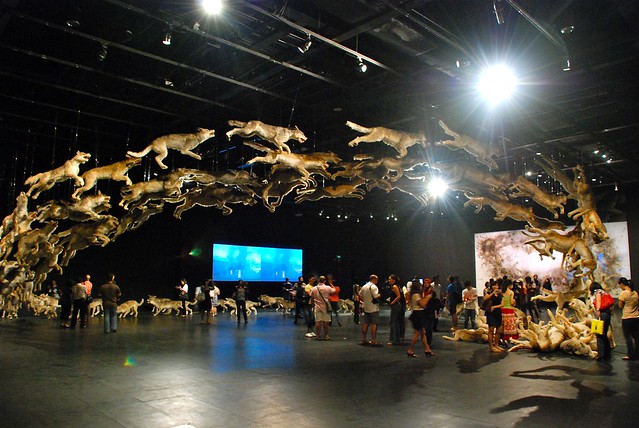
Head On, a major work by chinese-born contemporary artist Cai Guo-Qiang, which had his debut at Deutsche Guggenheim in Berlin in 2006, will be exhibited at the National Museum of Singapore from July 2. The show includes the eponymous installation, where replicas of 99 life-sized wolves, run fearlessly and collide one after another into a glass wall.
The exhibition consists of three parts: the eponymous installation Head On, the two-channel video installation Illusion II, which also documents the explosion project by the same title, and Vortex, a gunpowder drawing depicting thousands of wolves chasing one another in a circular motion. Vortex is also accompanied by a video featuring the artist while creating the drawing. What makes the installation at the National Museum of Singapore unique compared with the work’s previous sites is its presentation in a gallery completely painted in black. Not only does this dramatically complement the wolves’ silvery mane but it also invokes a new way of seeing the piece.
Head On, a major work by chinese-born contemporary artist Cai Guo-Qiang, which had his debut at Deutsche Guggenheim in Berlin in 2006, will be exhibited at the National Museum of Singapore from July 2. The show includes the eponymous installation, where replicas of 99 life-sized wolves, run fearlessly and collide one after another into a glass wall.
The exhibition consists of three parts: the eponymous installation Head On, the two-channel video installation Illusion II, which also documents the explosion project by the same title, and Vortex, a gunpowder drawing depicting thousands of wolves chasing one another in a circular motion. Vortex is also accompanied by a video featuring the artist while creating the drawing. What makes the installation at the National Museum of Singapore unique compared with the work’s previous sites is its presentation in a gallery completely painted in black. Not only does this dramatically complement the wolves’ silvery mane but it also invokes a new way of seeing the piece.
Original Post here.
Thursday, August 19, 2010
Getty Dalton Pencil Carving
Pencil – only a tool used for painting, drawing, or putting down notes in the margins. Getty Dalton turns ordinary pencils into miniature sculptures, without using a magnifying glass .
Original post here.
Original post here.
Subscribe to:
Posts (Atom)


_rdax_768x512.jpg)